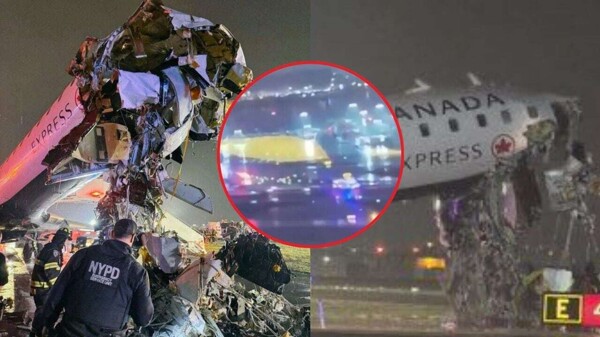
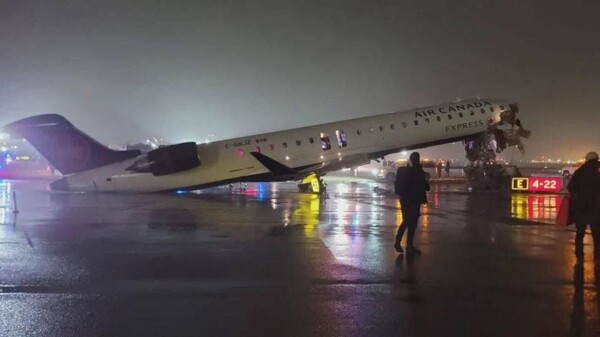
On Sunday night, an Air Canada Express flight, AC-8646, operated by Jazz Aviation, collided with a Port Authority fire truck at LaGuardia Airport in New York. The crash resulted in the deaths of both the pilot and co-pilot, dozens of injuries, and a total shutdown of operations at one of the most sensitive air terminals on the East Coast of the United States. For many of the occupants, the shock from the impact was as strong as the blow itself: no one could understand how a commercial plane that had just landed could end up embedded against an emergency vehicle in an international terminal subject to strict protocols. The accident reopened an uncomfortable debate for North American aviation: that of surface safety, a less visible area than flight itself but no less delicate. The impact occurred upon landing, when the plane collided with an emergency vehicle responding to a separate operational incident within the airport. Images taken at the scene showed the plane's nose completely destroyed, surrounded by emergency lights, ambulances, and response units. The Federal Aviation Administration ordered the suspension of all flights to LaGuardia, and the airport remained closed at least until Monday afternoon as technical teams began investigations on the runway. Among the injured were also members of the emergency vehicle, which suffered significant damage. In the U.S. aviation ecosystem, the mere possibility of a failure in that communication chain is viewed with extreme concern, even more so in a high-density airport like LaGuardia. Passenger accounts reinforced the magnitude of the event. Nevertheless, the collision was sufficient to cause a fatal blow to the cockpit and turn the scene into an episode of enormous operational severity, with severe human consequences and a strong question about runway control. U.S. authorities confirmed that the two pilots died after being transported to healthcare facilities. The incident also caused cancellations, delays, and diversions at other airports in the metropolitan area, impacting the peak travel season. The investigation was handed over to the National Transportation Safety Board, which will seek to reconstruct why the fire truck was in the aircraft's operating area as it completed its landing. The first known elements indicate that the fire truck had been dispatched for a separate incident linked to another flight and that, in that context, it had received authorization to cross the runway. It also exposed a failure that must now be examined with surgical precision, because in the answer to that question, something more than the explanation of a dramatic night is at stake: confidence in one of the most demanding airport systems in the world is at stake. Sources: Reuters, Associated Press, FAA. Additionally, 41 people were hospitalized after the accident, although the majority were discharged in the following hours. This fact opens a critical line of investigation into coordination between controllers, support vehicles, and air traffic. Some described an apparently normal landing followed by a sudden brake and a devastating impact that threw people and objects inside the cabin. The violence of the crash destroyed the front of the aircraft and forced the deployment of a major rescue operation, with immediate passenger evacuation, mass medical assistance, and terminal closure. Unlike some initial versions that circulated in the first few hours, verified reports do not place the impact at a speed of 200 kilometers per hour, but in the final phase of landing at a considerably lower speed. The LaGuardia tragedy left not only fatalities and the injured but also a sense of chaos.

Plane Collides with Fire Truck at LaGuardia Airport
On Sunday night, an Air Canada Express plane collided with a fire truck while landing at LaGuardia Airport in New York. The tragedy resulted in the deaths of both pilots, dozens of injuries, and the closure of a terminal. The incident has raised serious questions about ground safety and triggered a major investigation.